
What’s your metric for quality?
I’m in this mode of thinking that things of quality have no fear of time. I was reading something — I forget what it was — that a thing which has existed for a long amount of time will likely continue to exist for longer, as opposed to something that has only existed for a short amount of time, which is likely to be replaced sooner. Those are the things that become untrue, eventually.I think we should approach design and quality the same way. We build this thing, and it doesn’t have to be perfect, but it has to be of a certain quality, and it has to not just solve a problem but actually add to quality of life in some capacity. That’s my main metric for quality. And that should have no fear of time, because that’s what makes things last.

How do you design when you don’t like what you made?
I’m in a constant cycle of dissatisfaction, especially at the moment, where my mental and emotional state really does affect how I view my work.This is one of my main gripes from design school. We’d work on something really hard, it gets critiqued, and it’d be like — yeah, this is not personal. I understand it from a designer’s perspective, especially from a student perspective, or a collaborative one, where the thing truly isn’t personal, it’s truly just trying to achieve the best thing for the collective group and the best thing for your personal learning.There’s something in me that really wants to take everything personally, and to be honest it’s probably counterintuitive and bad for me in many ways. But I find that if I’m really invested in a piece of work, I will excel eventually. Even if I don’t like what I made, I know I’m going to persist with it, because I’m emotionally or personally invested. But if I’m not, then usually I just leave it. But yeah, that’s kind of my approach.
What do you want to be making in five years?
Definitely experience-based design, where I’m making things people can experience. For a long time I’ve believed that designers have more to learn from artists than artists have to learn from designers, and that’s kind of what I’m trying to do now — design like an artist, and get into this space where everything is really emotional.That’s not to say that art strictly has to be emotional. It’s more that I’m invested in a more emotional point of view, which connects to the previous answer. I just want to be more invested in the kind of work I do: more artistic, more emotional, more human, more personable. But ultimately I want people to experience it. I don’t want someone to just be — I want someone to enter. That’s the dichotomy of it.In five years I’d like to be in the experiential design space. Not just curating, but actually building these experiences. And I think there’s no better time than now, especially with AI.
What do most portfolios get wrong?
They just put a bunch of shit on there, haha. Like a bunch of projects. It needs to be concise and it really should be simple — as simple as possible. That’s really my entire answer.You should be able to see what work you’re doing and who you are in the first three seconds of seeing the site. Just avoid overwhelming with lots of copy. You don’t have swag. That’s not to say that everyone doesn’t have swag, but if your name isn’t known, then adding more copy doesn’t make you more credible. It doesn’t make you look any better — if anything it just means you’re already confusing as a person, and you’re just confusing them even more.Be as simple as possible, be as concise as possible, make it as accessible as possible, and make sure they can get to whatever you want them to actually see and know within a few seconds. Then you should be fine.Most portfolios are too bloated. There’s just too much going on, it’s not easy to navigate, there are too many layers. This is not a personal website — this is your professional, most front-facing touchpoint.
How do you know an idea is worth building?
Something I’ve lost in the last two years is collaboration. I was working very closely with a friend on a magazine and it really accelerated my career. Things were moving extremely quickly because I was in this momentum phase where me and a partner were really pushing one another, and two people will forever be able to achieve more than one. Especially when you can really disagree with each other, or really agree with each other and sync on a vision, but also tell the other person — oh, this is a terrible idea, we need to pivot, we need to do something else. Two will always be better than one.So it’s almost always people. That’s my actual answer: are the people building it with me worth building it with? Are the people I’m building it for worth building it for? If both of those boxes check, then usually it’s an idea worth building.When I say worth, I’m thinking from a point of view of — is this fulfilling, is this also productive? But is it going to be a successful idea? There are probably other metrics.
Questions by Grisha Obolenskiy, answers by Madani

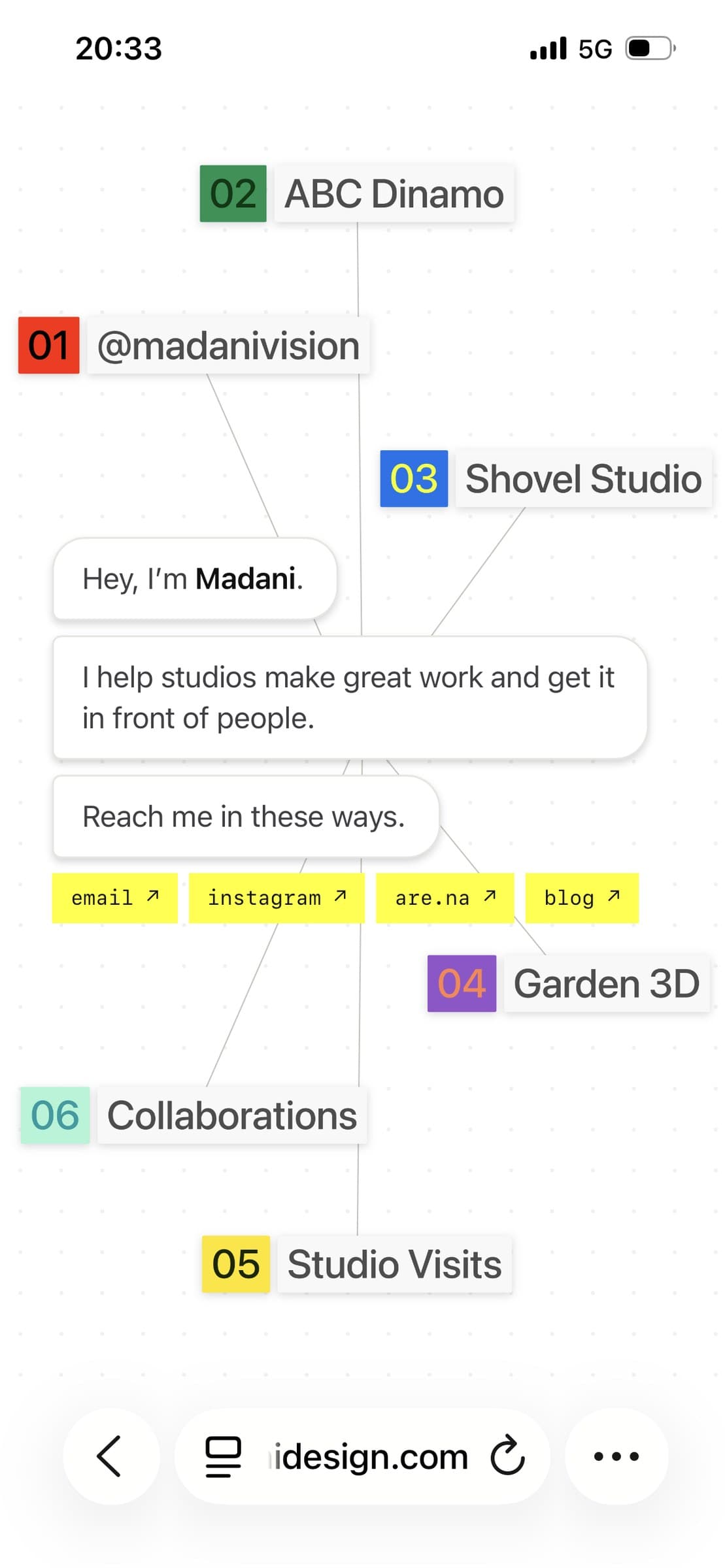
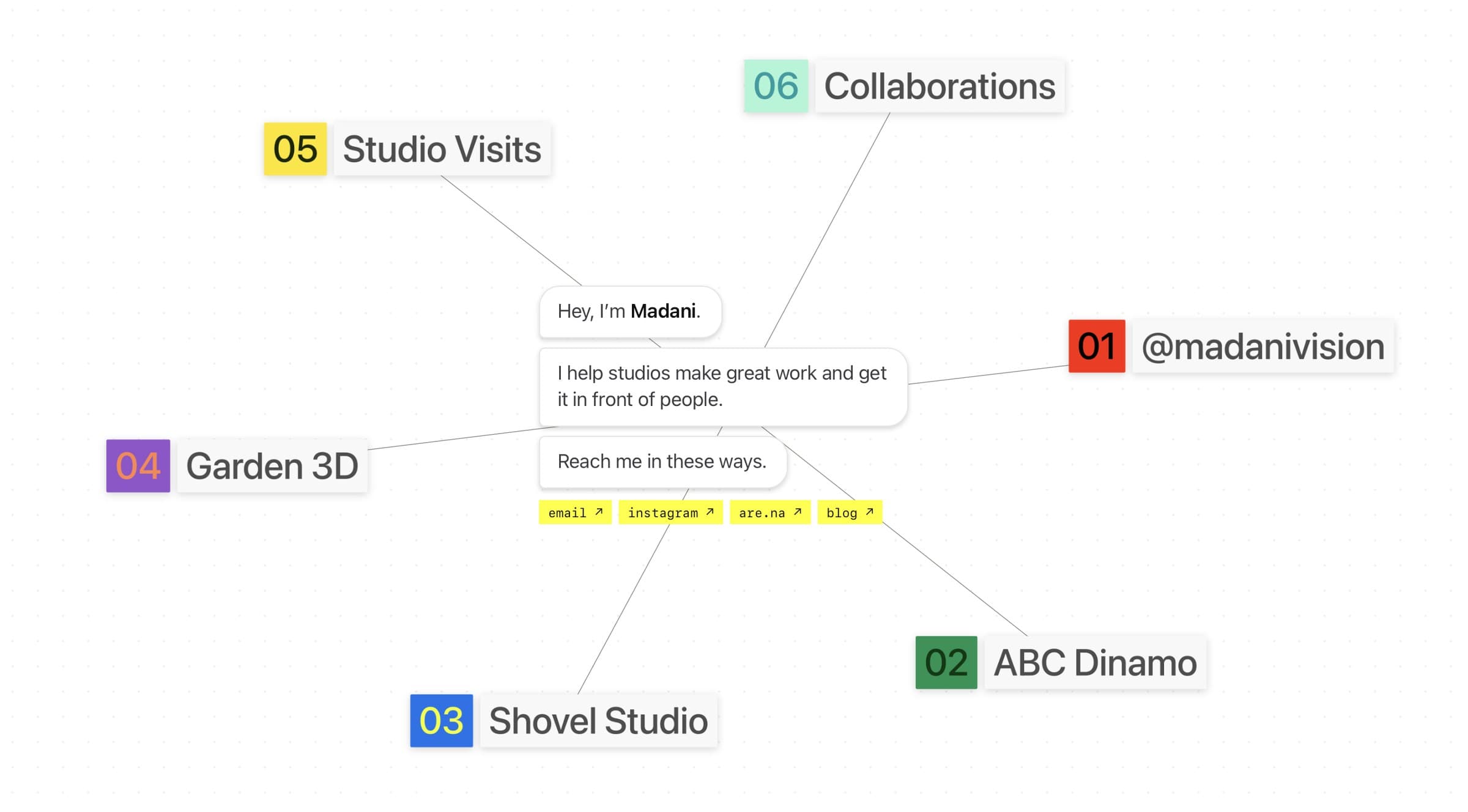
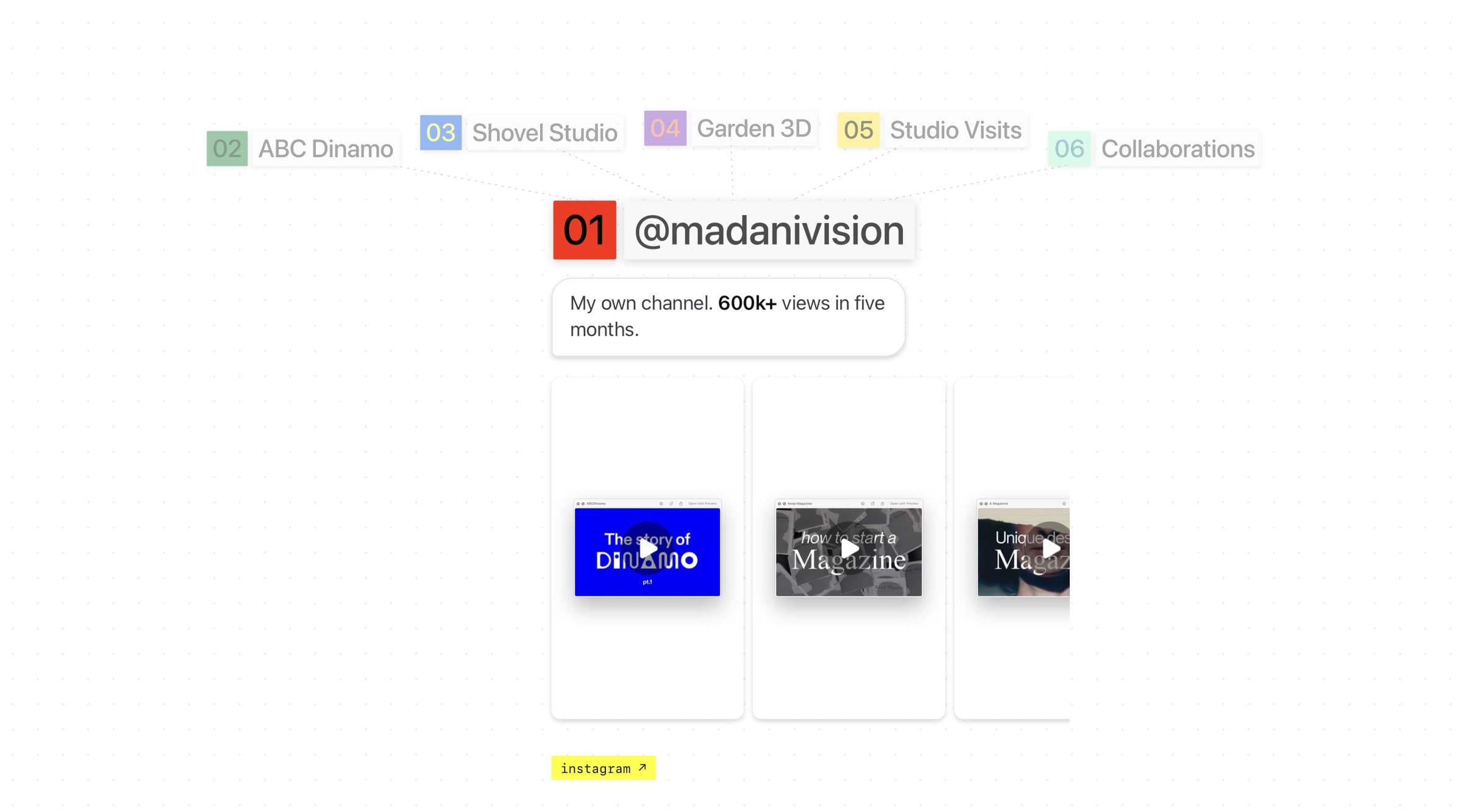
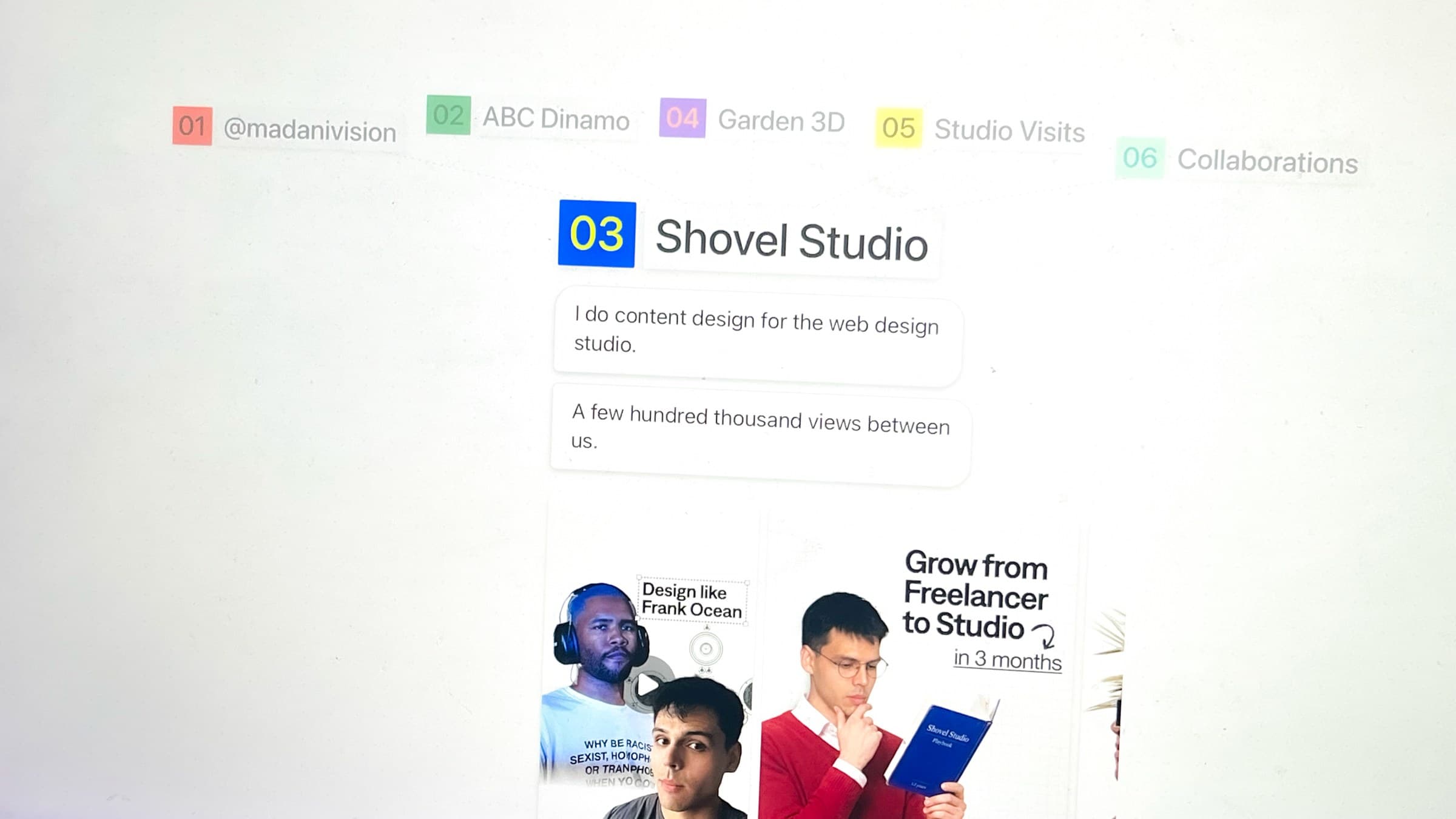
A portfolio written the way Madani wanted to be read — first person, talking straight to whoever opens it. It came out of a pitch deck he made for a studio he wanted to work with and could not be in the room to present, so the deck had to do the talking for him. It worked; they said yes. Four days, in a bedroom in Coventry.